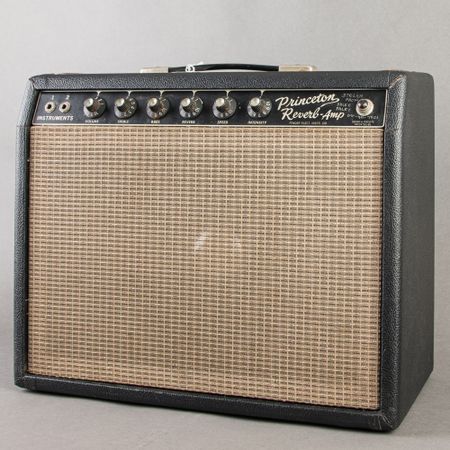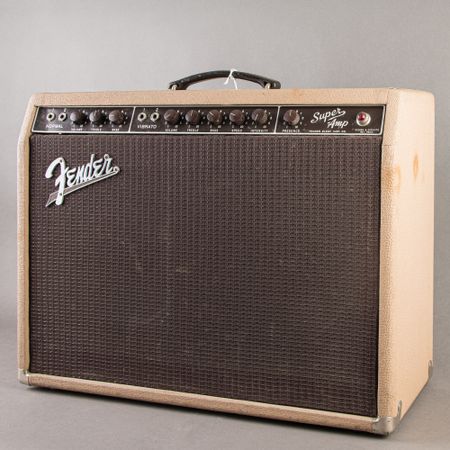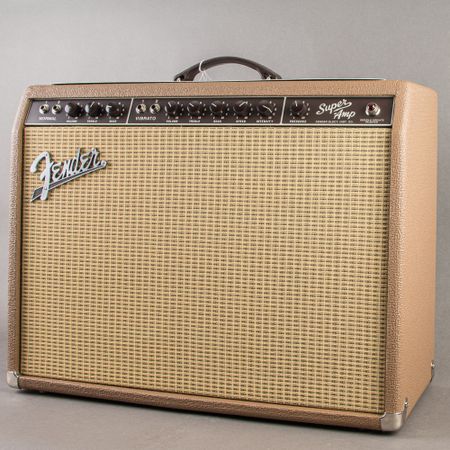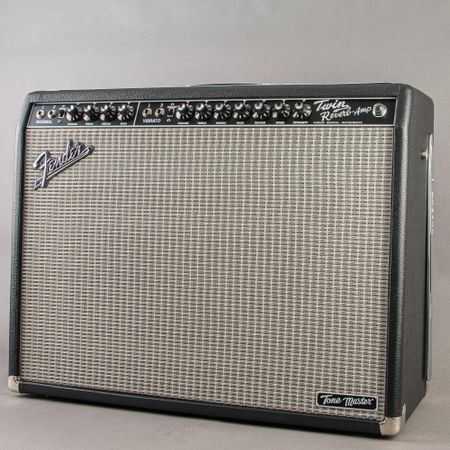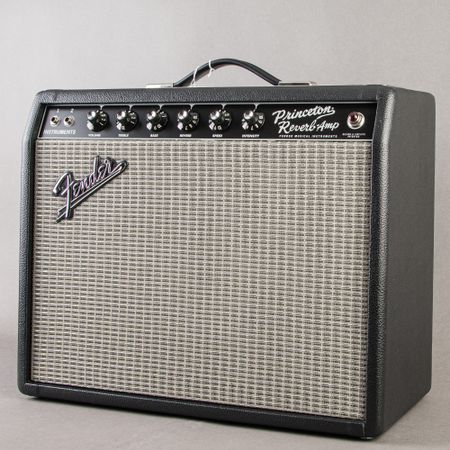

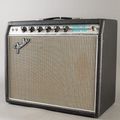
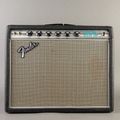
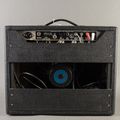
Fender Princeton Reverb Drip-Edge AA764 1968, Black
We accept Credit Card, ACH, Wire Transfer, Cash, Check, Affirm & Split Payments. Contact to discuss payment methods

Authenticated by Vintage Experts

Shipments Protected at Full Value

48-Hours Return Window
Want us to sell your instrument or get trade-in credit?
Click here to submit your instrument details Got questions? Call Us
Specs
| Instrument | Amplifiers |
| Brand | Fender |
| Model | Princeton Reverb Drip-Edge |
| Finish | Black |
| SKU | AP4023-A |
| Made In Year | 1968 |
| Preamp | 12AX7 (x3), 12AT7 |
| Power | 6V6 (x2) |
| Rectifier | 5AR4 |
| Wattage | 12 Watts |
| Circuit | AA764 |
| Speaker | Period Appropriate Fender Labeled Oxford 10L5 from '65 |
| Transformers | Original PT & OT, changed RT |
| PT | BC&T 022722/8316748 |
| OT | BC&T 022913/8316804 |
| Reverb/Other | Changed Modern P-TF22921 |
Description
This Princeton Reverb was built in early 1968, and features the "drip-edge" aluminum trim around the front baffle. In addition to this, the earliest transition era amps feature vertical black lines on the front silver panel, indicating a very rare and distinct example. Something that doesn't get mentioned much is the use of BC&T transformers for late '67, early '68 Princeton's - which translates to a bit more "edge" to the sound, displaying itself in an excellent way when driven to breakup.
The reverb transformer has been changed, which goes unnoticed in terms of sound quality.This amp has a changed power cord, electrolytic caps, along with most of the original coupling caps (one original "swedish fish" still remains). The reverb cables have been changed, but the original tank is still present. Also the V1 plate resistors changed out for modern carbon comp equivalents. A resistor was changed in the tremolo circuit as well, but otherwise the circuit has remained original. Despite a couple of changes internally this amp retains an authentic blackface sound, having kept the identical AA764 circuit as the previous mid-60's amps.
It should be noted there is some reverb ghosting when the control is turned down, which is just a quirk of original circuitry - when used in conjunction with a footswitch this issue is solved.
Similar Listings
Filter