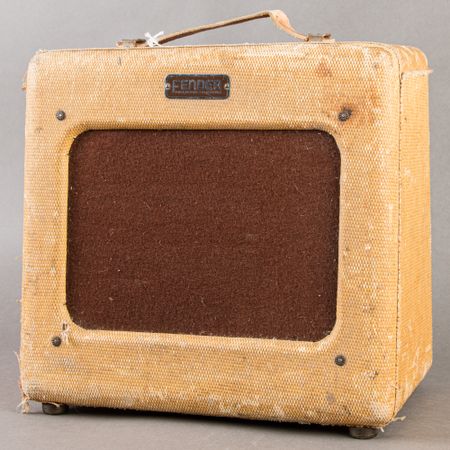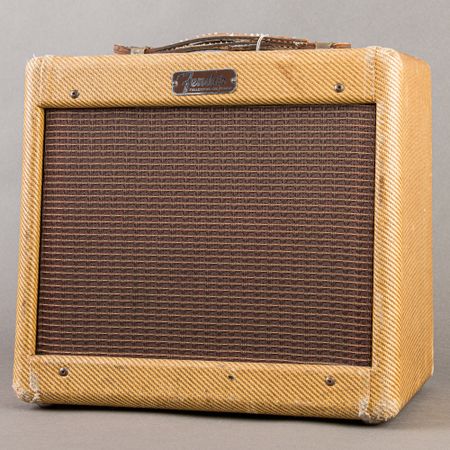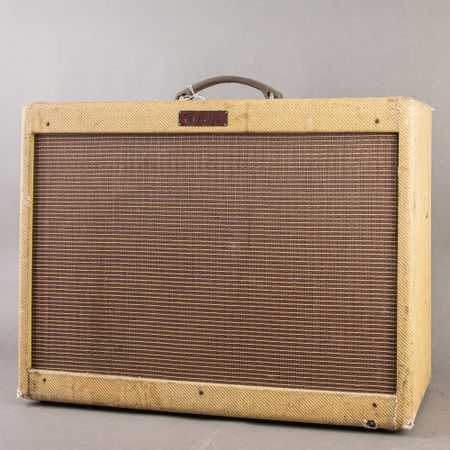



Fender Bandmaster 5C7 1x15 Combo 1953, Tweed
We accept Credit Card, ACH, Wire Transfer, Cash, Check, Affirm & Split Payments. Contact to discuss payment methods

Authenticated by Vintage Experts

Shipments Protected at Full Value

48-Hours Return Window
Want us to sell your instrument or get trade-in credit?
Click here to submit your instrument details Got questions? Call Us
Specs
| Instrument | Amplifiers |
| Brand | Fender |
| Model | Bandmaster 5C7 1x15 Combo |
| Finish | Tweed |
| SKU | AP3889-A |
| Made In Year | 1953 |
| Preamp | 6J5, 6SC7 (x2) |
| Power | 6L6 (x2) |
| Rectifier | 5U4 |
| Wattage | 25w |
| Circuit | 5C7 |
| Speaker | Original Jensen P15N |
| Transformers | Original Triad |
| PT | 6516 |
| OT | 1846 |
Description
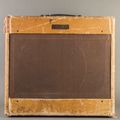
The Wide Panel Bandmaster is a very rare amp to come across. For those curious, the scarcity is rewarded with an even more unique Tweed sound, possibly the most aggressive and crunchy amp in the whole early '50s lineup! The octal tube Fenders always have their own distinctive sound, and this one features a very responsive Bass/Treble tonestack for dialing in the right balance for your instrument. Players should also be aware that octal tubes are a more primitive design and are prone to minor microphonic issues, along with a generally higher noise floor.
This is a fantastic example of a '53 Bandmaster, being that it's stayed completely stock electronically (other than a replaced power cable). The original P15N Jensen has been reconed but still retains its signature compressed sound. There is some debate about whether these speakers might hold the amp back a bit, but since it has an output jack, external cabinet experimentation is an option. The Tweed covering is well worn, which seems to be a fitting sign when an amp sounds as great as this one. Strangely, the upper back panel has been re-covered, and the rest is original. Don’t miss your chance to grab this rare early '50s gem!
While the amp is fully functional, the buyer should note that the circuit is completely original, including the long-expired electrolytic caps. The stock carbon comp resistors contribute to a reasonably high noise floor, so if the amp is intended for prolonged or gigging use, it will need servicing (electrolytic caps, etc.).
Similar Listings
Filter